Saturday, 3 December 2011

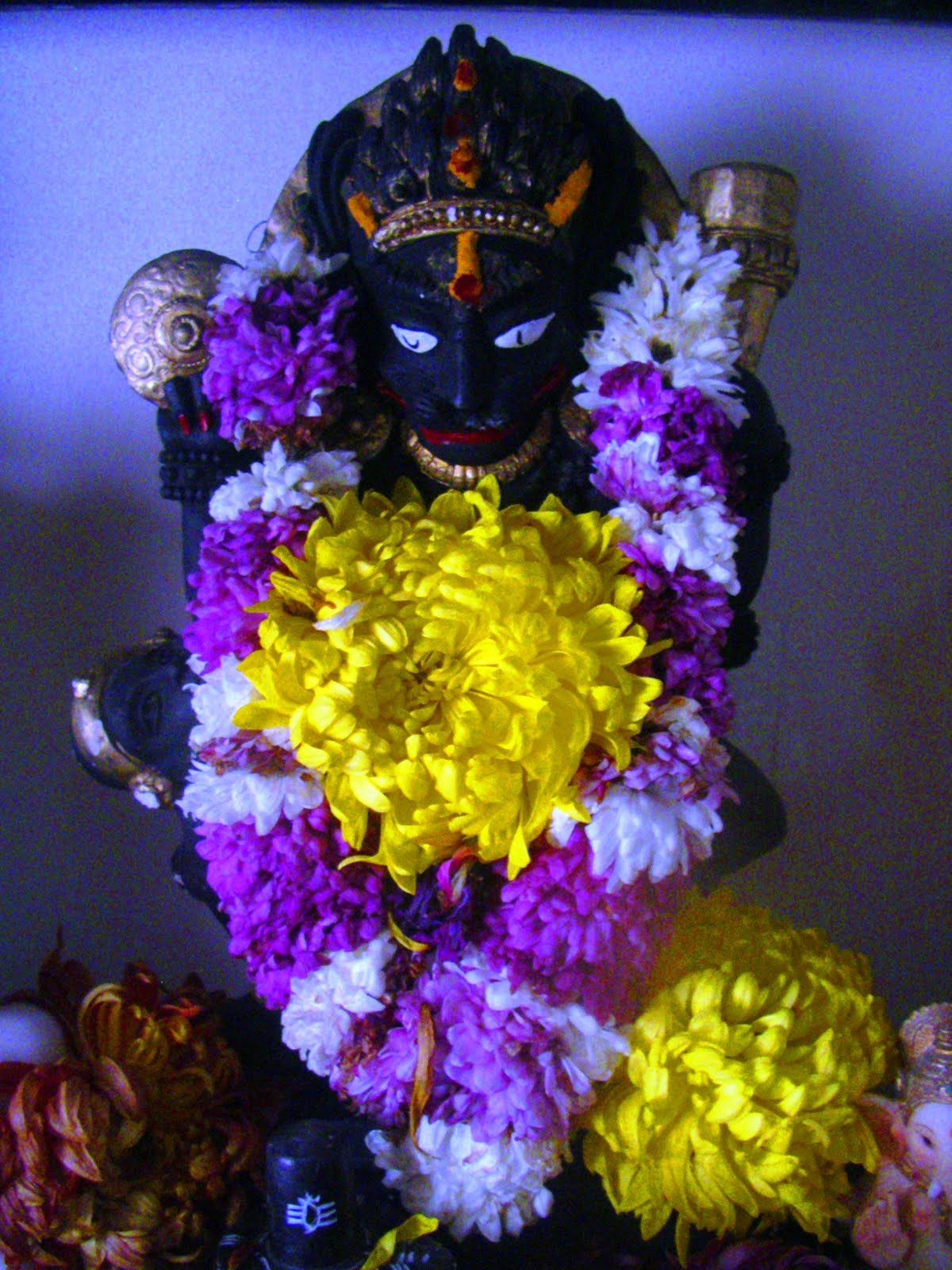
Sri Narasinga Kavacha


Meditating on your head, think:

Ksraum (meaning: Narasinga)

Ugram viram maha Vishnum jvalantam sarvatomukham Nrsimham bhishanam bhadram mrtyu mrtyum namamy aham

(Meaning: May my head be protected by the moon coloured one, who is the greatest among humans. My obeisances unto the ferocious and powerful, the great Visnu, the fiery one, who's faces are on all sides, the fearful one, Narasinga, who causes the death of even death personified).

Meditating on your neck, say:

Ksraum

Meditating on your heart, say:

Bhagavate (meaning: divine)

Meditating on your eyes, say:

Narasimhaya

Meditating on the top of your head, say:

Jvala maline (meaning: garlanded with flames/light)

Meditating on your nose, say:

Dipta damstraya agni netraya sarva raksho ghnaya sarva bhuta vinasanaya

(meaning: Obeisances unto Him, whose teeth are blazing, whose eyes are fire, and who destroys all ghosts and demons)

Meditating on your face, say:

Sarva jvara vinasaya daha daha paca paca raksha raksha. Ksraum ugram viram maha Visnum jvalantam sarvatomukham nrsimham bhisanam bhadram mrtyu mrtyum namamy aham. Ksraum bhagavate narasimhya jvalamaline dipta damstrayagni netraya sarva raksho ghnaya sarva bhuta vinasanaya svaha.

(meaning: Destroyer of all fevers, burn, burn, cook, cook, protect, protect. Narasinga, ferocious heroic, great Visnu, fiery one whose faces are on all sides, terrifying Narasinga, who can destroy death if you wish, I salute you. Unto the divine Narasinga, garlanded with fire/light, whose teeth and eyes are fiery, who kills all rakshasas and demons and annihilates the ghosts, hail/oblations.)

Meditating on your rectum, sip water and say:

Ome Ramachandra namah. (meaning: hail Rama)

Meditating on your hands, sip water and say:

Klim (meaning: Kali)

Meditating on your feet, say:

Ome namah

Meditating on your sides, say:

Narayanaya am Hrim Kraum Ksraum hum phat (meaning: Vishnu, Parvathi, Narasinga)

Meditating on your waist, say:

Ome

Meditating on your feet, say:

Ome namo Bhagavate (meaning: homage to God)

Meditating on your back, say:

Vasudevaya (meaning: Krishna)

Meditating on your thighs, say:

Klim Krishnaya

Meditating on your knees, say:

Klim Krishnaya

Meditating on your feet, sip water and say:

Klim Glaum Klim syamalangaya namah (meaning: Kali, Ganesh, hail)

Meditating on your limbs, say:

Ksraum Narasimhaya Ksraum

Tuesday, 4 October 2011

Has slavery been abolished in the West, or are we all actually slaves to our own greed?

Living in debt:
An invitation to financial slavery
I first went into debt when I was a student physiotherapist. My bank account went 50 pence overdrawn. I was horrified and asked my mother for a loan to cover it until my next student grant cheque came through. I was still in debt, but being in debt to my mother did not seem as bad as being in debt to the bank. When I graduated, my parents wanted me to buy a house. I could not bear the thought of taking out a mortgage and being thousands of pounds in debt, so I did not listen to them. In hindsight, looking at house prices now, perhaps I was unwise to ignore their instructions, but not having a mortgage gave me the freedom to do what I thought was right by leaving an NHS management job, and a Council Housing job. In both of those jobs I felt that my managers were pressuring me to be dishonest, and I have seen evidence that these were not isolated cases.[1,2] If I lived in fear of not being able to pay off my mortgage, perhaps those managers could have kept me under their thumbs.
Luxury

Material attachment:
Since that time, debt has become a normal part of my life. I am currently over £12000 in debt, yet, if I ignore that fact, I could be under the illusion that I am better off than people without such debts, who ask for money in the street. Am I, or am I a slave? Much of my current debt was necessary for my karma yoga. I believe it was my duty to be a student occupational therapist, and that it is my duty to be a medical student now. As a student, I needed to take out loans to survive. My debt never needed to be as big as it is though. While working for the council housing department, I bought myself a Mitsubishi 3000GT. It was great fun, but my insurance was £1500 per year third party only! The tyres cost £200 each to replace and when I put my foot down it drank like a whale. One day whilst I was on an excursion with an attractive woman, the gearbox failed, costing me £1500 to repair. Wiser people told me to get rid of the car at this point, but I was too attached to it. Later, the exhaust and alarm systems also failed, and the gearbox failed again, resulting in a court case to recover my costs from the people that did not repair it properly the first time. I finally saw sense and gave the car away to another foolish materialist. After that, I bought two Toyota MR2s which were much more reliable and cheaper to run. Unfortunately, one was hit by an uninsured driver and its engine blew up, and the other was run over by a lorry. Due to my psychological attachment to those cars, both incidents caused me stress. Now, driving an Aygo, which drinks very little petrol and costs less than £50 per replacement tyre and less than £200 per year for fully comprehensive insurance (but unlike the sports cars, does not attract any attention from women) I am aware that I was a slave to my sports cars.

Lesser luxury
Debt culture:
I am not alone in being in debt. At the moment, it seems like almost everybody is in debt, including the Greek, our own and the US governments. They strangely had enough money to invade Iraq and Afghanistan though. Who on Earth do all of these people actually owe money to? I asked a banker and he kind of said “each other” but that does not make any sense to me. I used to think the Zeitgeist movies[3] were paranoia, but the current situation leads me to re-think that. There is always somebody else to blame. People have complained that doctors get paid too much and public sector workers pensions are unfair. I think those people should try medical school and public sector employment to see whether they can hack it before complaining. Similarly, scape-goating of bankers seems to be a popular pastime nowadays. If you feel jealous, try being a banker before complaining. Did anybody hold a gun to your head and force you to buy things that you cannot actually afford?

It seems that many want to blame and heavily tax ‘the rich’. I agree that tax-evaders should be forced to pay up, but as higher earners that do pay their tax, pay more tax than low earners, I do not think it would be fair to penalise them for their hard work while so many people are happily living off the state with no intention of contributing to society in any way. If rich people are over-taxed in Britain, what reasons will they have to stay here instead of moving to more sensible countries? I think taxes should be based on how ethical your earnings are. If you exploit people by selling necessities such as food, fuel or accommodation at inflated prices, you should be taxed heavily, while if you sell necessities at reasonable prices or make your profits by selling luxuries that people do not actually need, but choose to buy, why should you be penalised for your success?

I believe the solution to our problems can be found in Isa Upanishad:


Omé pūrṇam adaḥ pūrṇam idaḿ pūrṇāt pūrṇam udachyate
pūrṇasya pūrṇam ādāya pūrṇam evāvaśhiṣhyate


(The Invisible Absolute is whole; the visible Universe is whole; from the Invisible Whole comes forth the visible Universe. Though the visible Universe comes from the Invisible
Whole, the Whole remains unaltered.)

Iśhāvāsyam idaḿ sarvaḿ yat kiḿ cha jagatyāḿ jagat
tena tyaktena bhuñjīthā mā gṛdhaḥ kasya svit dhanam

(Everything that is within the universe is controlled and owned by the Lord. One should therefore accept only those things necessary for oneself, and one should not endeavor to gain anybody else’s wealth).

Eight month's supply of food (+ about 4 months supply of drink) <£2 per day.
On a personal level, this means not borrowing money to buy things you do not need, and on a national level it means not invading other countries supposedly in search of non-existent weapons of mass destruction regardless of how much oil they have.

In Western Societies perhaps this is easier said than done. When I was in Sri Lanka I saw a house built in 3 days. Similarly when watching a television program about Nigeria, I saw people making land out of rubbish and saw dust, building huts out of corrugated iron and growing fish to eat in the water where they lived. I have never seen anything like that happen in England. It is too difficult to live simply here. I remember seeing on the news when I was a child that an African woman got into trouble here for building a mud hut without planning permission. Similarly, some of the so called ‘travellers’ who wish to live in buildings at Dale Farm instead of travelling seem to have run into trouble with their local council due to lack of planning permission for building on land that they themselves own.[4] I may be naive, but if it is on land they own, where nobody else is likely to go, why is planning permission such an issue? Why does everything in England have to be so complicated? My mother cannot even get permission to have the curb in front of her house dropped to prevent tyre damage to cars accessing her driveway.

Pure greed:
Necessity
Why are houses so expensive here? It is insane. I
think firstly it is because people are willing to pay that much and be mortgage slaves instead of seeking more simple living elsewhere.[5] I also think landlords have a lot to answer for. If there was a very high ‘landlord tax’ that made it financially insensible to own any residential property that you yourself did not live in, I think landlords would have to sell all of their properties and house prices would come down. Personally I do not think it is ethical to make money out of people that cannot afford their own places to live. I used to think that if things kept going the way they are, sooner or later there would be a revolution here! A few weeks ago when riots seemed to be springing up all over the country, I thought it had started. In reality what happened was nothing like a revolution, but just another mass expression of greed. People dressed from head to toe in branded sports goods were interviewed on television saying that the riots and looting were because they are poor. Instead of attacking the Royal Family, The Bishop’s Avenue, or Harrods, they attacked small businesses in their own local communities and looted items that no human really needs. People ridiculed those seen stealing rice, because rice is so cheap, but of all the rioters and looters, I respected them the most, because their choice suggests to me that they really were poor, and just wanted food, while others were more interested in trainers from Footlocker. One person on television, when trying to justify the looting, defined his 'poverty' in terms of finding it difficult to pay off his mortgage! I cannot even afford to get a mortgage. Should I help myself to a widescreen television from Comet and some trainers from Footlocker?

Definitely not necessity
There was no shortage of people making excuses for these criminals. Somebody sent me a Facebook message saying:

“it's not about making excuses for them, but ignoring the reasons and
social issues dictating behaviour will only cause more problems for our society. for example, if you remove social housing and benefits from everyone convicted with rioting, these newly homeless people with no money will probably turn to crime, targeting the most vulnerable in our society”

Wanting everything for nothing:
Despite this, I think the looters could benefit from Isa Upanishad just as much as the landlords. So too could those who choose to live off the state. For a short period of my life I was unemployed and spent my time relentlessly applying for jobs. It was depressing, but I noticed that most people visiting the job centre I went to were not even bothering to look at the advertised jobs; they were simply going there to sign up for job-seekers allowance. I saw one woman smile in the face of the job centre employee who told her off for not actually job-seeking. She still got her job-seekers allowance. Previously on Channel 4’s Tower Block of Commons I saw people living in conditions better than I can afford, having produced
Depressing but necessary
more children than I could afford to raise, complaining to MPs about
how poor and hard done by they are. Strangely at least one of them could afford to blow a huge proportion of his benefits on tobacco consumption. Should the tax-payers really be paying for his tobacco consumption? More recently I saw a single mother with 8 children on television, describing her financial hardship. In a news story about Parent Gyms, a mother of 10 children complained about how difficult it was to control her youngest two children. Is this planet big enough for every human mother to have 10 children? Contracepton is free in the UK. What excuse is there for producing more children than you can cope with or afford to raise? These people may not be living in slavery, but they are living off the slavery of other people who work and pay taxes.

Speaking of people living off the state, I am sick of students complaining about tuition fees while they seem to have enough money for sufficient alcohol to get themselves drunk. Drunkenness is not a necessity is it? Why then should it be government subsidised? I know graduates who are unemployed and have no idea what they want to do with their lives. What was the point of their government subsidised higher education? Did they really need it? Did it make any difference? One of the excuses I have heard from fight fees campaigners demanding free degree level education is that people learn social skills at University! Is that really needed, or is it a luxury? Should it really be subsidised by the taxpayer? I think that only higher education that is actually going to benefit the country should be government subsidised. If students want to study unnecessary degrees, they should pay for them themselves, instead of expecting the taxpayer to subsidise them, or even worse, pay for them completely.

Conclusions:
In short:
Student vice: should not be supported by the taxpayer

1. If you expect the government (i.e. the British tax-payer) to pay for your excessive progeny, alcohol and tobacco consumption, laziness and your useless education, hello! There is a national debt crisis. Wake up!

2. If you are making a profit by renting residential property that you yourself do not need to live in, or selling necessities at highly inflated prices, you are forcing other people into poverty. Karma will catch up with you sooner or later.

I expect this blog entry to be very unpopular, but there it is. Rant over.

References:
1. Revill J. (2003) Hospitals faking cuts in casualty wait times. Available from: http://www.guardian.co.uk/politics/2003/may/11/health.nhs1 Accessed: 4/10/2011
2. Mailoo V.J., Abrahams P., Warner E., Wickham J. (2005) Council housing: getting what your service user needs. Therapy Weekly 31(29):11-14
3. http://zeitgeistmovie.com/ Accessed: 4/10/2011
4. Haddadi A. (2011) Dale farm Eviction: “Ethnic Cleansing” or Just Planning Permission Issues? Available from: http://uk.ibtimes.com/articles/216193/20110919/dale-farm-eviction-ethnic-cleansing-or-just-planning-permission-issues.htm Accessed: 5/10/2011
5. Knight K. (2010) My Masai Mr Right: Why is this middle-class woman giving up a life of luxury to live in a mud hut with an African warrior? Available from: http://www.dailymail.co.uk/femail/article-1262574/My-Masai-Mr-Right-Why-middle-class-woman-giving-life-luxury-live-mud-hut-African-warrior.html Accessed: 5/10/2011

Wednesday, 7 September 2011

Reasons to be vegan....

For some time now I have been studying the Hare Krishna Vaishnav (worship of Lord Vishnu) tradition thanks to the International Society for Krishna Consciousness (ISKCON). One thing confused me about this for some time. Vegetarianism is one of their precepts, as it seems to be for most yoga traditions. One might believe that all of the heroes of the Vaishnav tradition were vegetarian, but when Arjuna first met Lord Shiva, both of them had just shot the same boar with their arrows. If Arjuna was vegetarian, what was he doing shooting a boar? I asked several Vaishnavas this question and got the same lame answer several times: “Warriors had to hunt to practise their fighting skills.” What kind of warrior shoots at helpless victims that are either a) unaware of the warrior’s presence due to being stalked or b) running away in fear? Nobody thought to tell me that the boar had attacked Arjuna and he was acting in self-defence. In my mind, such an explanation would have been more justifiable. A priest, who knew me well, finally gave me a more honest answer. He told me that Vaishnav warriors were permitted to eat meat!
 Hunters nowadays seem to be frowned upon, even by people who hypocritically eat meat. I was watching a documentary on bears the other day, and a family of hunters were interviewed on their bear hunting habits.At first, my eyes rolled, but then they served up a bear burger, and I though, “fair enough.” Perhaps fox hunting would not be so bad if the hunters had to eat the foxes they caught, and put their skins to good use for the manufacture of shoes etc. Hunting seems like a much more humane use of animals to me than battery farming, which looks far more horrific. I am allergic to most dairy products. This worried me as ISKCON seems to me to value dairy very highly in the diet. I asked the priest (mentioned above) whether my dairy allergy was an indication of my demonic nature, and he told me it was not. He said it was an indication of the demonic nature of today’s dairy industry. I have seen animals beaten, shocked with electricity, force fed and castrated without anaesthetic. Is hunting really worse than this?

Last time I was in Sri Lanka cattle were roaming the streets. At the time I gave this no thought, but having read about www.ahimsamilk.org I have realised this was because few people in this Buddhist-Hindu country were willing to kill cattle that did not produce milk. My grandmother had a cow in her back garden, and it gave us fresh milk daily. I never thought about what happened to its calf, and to this day, I still have no idea, as my grandmother and father passed away before I had a chance to ask them. On reflection, I think use of dairy products today may be less humane than eating hunted meat! The problem is, if I wanted to eat meat for vitamin B12, haem and calcium, I would have no idea where to find hunted meat. I am pretty sure most if not all of the meat served up in supermarkets is farmed, if not battery farmed. Ahimsa milk appears to offer an ethical alternative to those that can afford it, but as I cannot, I think I will stick to a mostly vegan diet instead.

V

Saturday, 18 June 2011

Do you want to save people from rape? Act now:

The Sri Lankan armed forces have a long history of rape, not only in their own country, but during tours abroad as well.[1] Footage soldiers filmed themselves, recently broadcast by Channel 4, suggests that they consider rape to be a sport.[2] This information is not news to Tamil people from Sri Lanka. It is one of the reasons so many Tamil people have fled Sri Lanka since the 1950s:

“the Council upheld the propriety of a letter from P. Alles published in The Island newspaper which had denounced lesbians while calling for convicted rapists to violate them sexually as an appropriate punishment.” (www.gaytoday.com, 2000)[3]

“Three (7%) of the 38 said they had been given electric shocks to their genitals, 26 (68%) had been assaulted on their genitals, and four (9%) had sticks pushed through the anus, usually with chillies rubbed on the stick first. One said he had been forced to masturbate a soldier manually, three had been made to masturbate soldiers orally, and one had been forced with his friends to rape each other in front of soldiers for their “entertainment”” (The Lancet, 2000)[4]

“She was taken to a lonely spot near the checkpoint and raped by six policeman and soldiers. . . . . . She had her face covered with a shopping bag containing chilli powder mixed in petrol, was beaten with wires and a pole, had paper pins driven under her finger and toenails, and had a plantain flower covered in chilli inserted into her vagina. She alleges police forced her to write and sign a confession admitting to being an LTTE member.” (www.wsws.org, 10 July 2001)[5]

“Two young women in the northern island of Mannar were stripped naked, gang raped, beaten and paraded naked in front of police officers. Their hands and feet were tied to a pole and they were suspended for an hour and a half while being beaten once again with thick wire.” (BBC News, 28 January 2002)[6]

“airport security personnel approached her and questioned her whether she was going to Kuwait and asked her what was the name of her employment agency. Despite answering his questions, she was told that she needed to be searched again. She was forced into a room on the 1st floor of the airport where civilians are not allowed to enter. There she was confronted by the other three airport officers; one security personnel and two casual workers from the Janitorial Services Company. They then threatened her by revealing a knife before taking her to the cleaners' quarters where they drugged her. She reported that the perpetrators forced her to drink a powdery substance and soon after she became unconscious. The four alleged perpetrators then raped her. As the victim’s flight time approached, one of the perpetrators accompanied her to the awaiting aircraft. The victim was placed on the aircraft and flew out of the country. As a result, the victim was deprived of her right to make an immediate complaint regarding the incident.” (Asian Human Rights Commission, 21 October 2005)[7]

“a woman who had been gang-raped in a police station in Amparai district was killed; a grenade in her vagina erased all evidence. . . . . . soldiers turn their fury on the first available target. Of course, the only people around are civilians. They open fire on everyone, they destroy everything in sight, they rape and torture people they catch on the streets or in their homes, they lob bombs into homes and schools, markets, and city streets. I’ve tried to stop them, I try to control the situation. I can’t. None of us commanders can—though god knows some don’t try. The troops just take off like this and there’s no stopping them. We can’t discipline them. We can’t prosecute them. We can’t dismiss them—we’d have no army left if we did.” (Politics & Society, March 2009)[8]

“Sri Lankan soldiers were accused of systematically raping Haitian women and girls, some as young as 7 years old. . . . most of the 114 Sri Lankan soldiers deported back to Sri Lanka from Haiti in 2007 for sexual abuse and rape in Haiti did not get punished.” (Open Salon, 9 November 2009)[9]

“A nine-year-old girl studying in the 5th Grade was raped by soldiers attached to the Digiliwatiya Camp at Batticaloa. The victim is a student of the Sinthandiya School at Digiliwatiya.The rape has led to protests by the villagers of the area which in turn has led to retaliation on the part of the soldiers from the camp who have ridden into the village on their motorcycles to harass the villagers. One of the protesters was killed and his body found in a pond near the army camp.” (Sri Lanka Guardian, 23 February 2010).[10]

Tamil people have been asking for international help for as long as I have been alive. Governments from other countries seem to have turned a blind eye to it though. Several other Governments contributed to the arming and training of Sri Lanka’s oppressive regime, and Tamil people have been stigmatised as terrorists.[1] The Sri Lankan government’s censorship and propaganda machine has successfully covered up most of its atrocities and blamed everything on Tamil terrorism, to the extent that even people in Sri Lanka that do not live in the historically Tamil areas largely believe that nothing is wrong. When I tried to raise awareness of this issue during the latest (and most concentrated) massacre in 2009, some people that I thought were my friends, told me that they would rather not know. Luckily, Channel 4 has highlighted the plight of Sri Lankan Tamils. It seems that despite this, some people may still be happier to turn a blind eye to the problem:

“Watching these films made me retch and I wonder quite what the purpose was of viewers being exposed to such horror. Snow said he believed the films should be made public, but why to the British public?” (The Telegraph, 15 June 2011)[11]

If you have read this far, please think of the Tamil people still trapped in Sri Lanka, and think of the Tamil refugees here that are at risk of deportation. A minority of Tamil immigrants have proven themselves to be criminals, and I would like to see them sent back to Sri Lanka, but what about the rest?[12] Is it really ethical to leave people trapped in a country where they are likely to be raped or killed on the basis of race, or even worse, send them back to such a country once they have tried to escape?[13, 14] Please consider writing to your MPs, requesting refuge for Tamil civilians that escape from Sri Lanka: http://findyourmp.parliament.uk/ If you have any doubts, about this course of action, the pictures below may convince you. I strongly discourage you from reading or looking any further though, because this blog is about to get nasty.

THE PICTURES BELOW ARE LIKELY TO DISTURB YOU AND POSE A RISK TO YOUR MENTAL HEALTH. UNLESS YOU ARE BATTLE HARDENNED, THINK VERY CAREFULLY BEFORE READING ANY FURTHER. I CANNOT ACCEPT ANY RESPONSIBILITY FOR YOUR DECISION TO LOOK AT THE PICTURES.

Sinhalese Nationalists reading this blog will probably proclaim that I am a terrorist. Sinhalese Nationalists are very fond of claiming that it was the Tamil terrorists that were committing rape, but they are unable to produce any shred of evidence.

“The observed absence of sexual violence on the part of LTTE cadre toward civilians is best explained by the theoretical framework’s top-down implication: Such violence is banned by the leadership and the organization’s strict internal discipline enforces the prohibition.” (Politics & Society, March 2009)[8]

The LTTE certainly committed acts of terrorism:
“In early August, LTTE cadre killed more than one hundred men and boys attending services at two mosques. . . . . In 1985, the LTTE killed 146 civilians in an indiscriminate attack near an important Buddhist temple in Anuradhapura. More recently, despite the nominal ceasefire in place, in 2006 the LTTE killed more than one hundred Sinhalese civilians in various villages in the northeast, including sixty-eight in the village of Kebithigollewa. The LTTE also kills civilians in the course of its political assassinations, often carried out in public settings with blatant disregard for the inevitable accompanying civilian casualties” (Politics & Society, March 2009)[8]

The LTTE’s attacks on civilians were unjustified, and ultimately that is why the LTTE is no longer. When my father was alive, he told me the LTTE was unethical and should not be supported. No terrorist organisation can survive without support, and by behaving unethically the LTTE lost its support. Based on relatively recent events, I am starting to think the LTTE was the lesser of two evils. Perhaps all there is to look forward to in Sri Lanka, is never ending oppression of Tamil people. Sinhalese Nationalist, government-orchestrated terrorism was going on for 19 years before Tamil terrorism emerged. I have seen no reason to believe this has stopped or will stop. If you want to see for yourself what I am talking about, look at the pictures below. These pictures represent just a small snapshot of what has been going on in Sri Lanka since the 1950s. If you want more information, you can find it at: http://www.srilankanatrocities.com/

References:
  1. Jivan (undated) Occupational Alienation: a personal perspective. Available from: http://www.metaot.com/blog/occupational-alienation-personal-perspective Accessed 18/6/2011
  2. Snow J. (2011) Sri Lanka's Killing Fields. Available from: http://www.channel4.com/programmes/sri-lankas-killing-fields/episode-guide/series-1/episode-1 Accessed: 18/6/2011
  3. GayToday (2000) Raping Lesbians Upheld by Sri Lanka's Press Council. Available from: http://www.gaytoday.com/garchive/world/060500wo.htm Accessed 18/6/2011
  4. Peel M., Mahtani A., Hinshelwood G., Forrest D. (2000) The sexual abuse of men in detention in Sri Lanka. The Lancet 355(9220):2069
  5. Silva V. (2001) Protests in Sri Lanka against the rape and torture of Tamil women. Available from: http://www.wsws.org/articles/2001/jul2001/sri-j10.shtml Accessed: 18/6/2011
  6. Harrison F.(2002)'Rape by Sri Lanka police grows' Available from: http://news.bbc.co.uk/1/hi/world/south_asia/1786835.stm Accessed 18/6/2011
  7. Asian Human Rights Commission (2005) SRI LANKA: Rape of a female passenger by the airport officers inside of the Bandaranayake International Airport. Available from: http://www.humanrights.asia/news/urgent-appeals/UA-183-2005 Accessed: 18/6/2011
  8. Wood E.J. (2009) Armed Groups and Sexual Violence: When Is Wartime Rape Rare? Politics & Society 37(1):131-162
  9. Danto E. (2009) Letter to the UN asking for investigative reports on UN rape. Available from: http://open.salon.com/blog/ezili_danto/2009/11/09/letter_to_the_un_asking_for_investigative_reports_on_un_rape Accessed: 18/6/2011
  10. Sri Lanka Guardian (23 February 2010) Army officers raping a nine year old girl; Can the new army commander maintain army discipline? Available from: http://www.srilankaguardian.org/2010/02/amy-officers-raping-nine-year-old-girl.html Accessed 18/6/2011
  11. Davies S. (2011) Sri Lanka's Killing Fields, Channel 4, review. Available from: http://www.telegraph.co.uk/culture/tvandradio/8576015/Sri-Lankas-Killing-Fields-Channel-4-review.html Accessed: 18/6/2011
  12. Majumdar D. (2007) Tamil gangs tackled from 'within' Available from: http://news.bbc.co.uk/1/hi/england/london/6380817.stm Accessed: 18/6/2011
  13. Belfast Telegraph (16 June 2011) UK 'has Tamil blood on its hands' Available from: http://www.belfasttelegraph.co.uk/news/world-news/uk-has-tamil-blood-on-its-hands-16012681.html Accessed: 18/6/2011
  14. Miller J. (2011) UK goes ahead with deporting 42 Sri Lankan asylum seekers. Available from: http://www.channel4.com/news/campaigners-outraged-over-sri-lanka-deportations Accessed: 18/6/2011